Lumpectomy Surgery Near You in Staten Island, NY
For patients diagnosed with breast cancer or a suspicious breast abnormality, lumpectomy is one of the most effective surgical options available. It removes the tumor while preserving the breast. Richmond University Medical Center is a full-service hospital near you in Staten Island, New York. We serve patients across the borough and surrounding communities with expert surgical and cancer care.
Our board-certified surgeons work alongside a multidisciplinary oncology team to evaluate each patient’s situation, explain all available options, and develop a personalized treatment plan. Whether you are preparing for your first consultation or ready to move forward with surgery, learn how we can help guide you through every step of the process.
Key Takeaways
- Lumpectomy removes a tumor and a margin of surrounding tissues while preserving the breast, offering comparable outcomes to mastectomy for many patients with early-stage breast cancer.
- Whether you are a candidate depends on your tumor size, its location, surgical margins, and individual factors.
- The procedure is performed on an outpatient basis under general anesthesia, with a recovery period of two to four weeks.
- Richmond University Medical Center provides local access to surgical and cancer care, with coordinated treatment planning and follow-up support at every stage.
What Is a Lumpectomy?
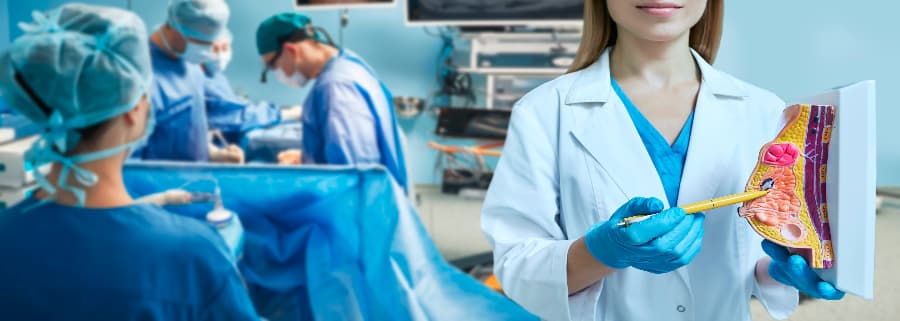
A lumpectomy, also called a partial mastectomy or segmentectomy, is a procedure that removes a cancerous or abnormal tumor along with a rim of healthy surrounding tissue, called the surgical margin. The goal is to eliminate the problematic tissue while leaving as much of the healthy breast intact as possible.
While it is like a mastectomy, there is a key difference. A mastectomy removes the entire breast, whereas a lumpectomy targets only the affected area. For patients with early-stage breast cancer or certain high-risk but non-cancerous conditions, research has shown that a lumpectomy followed by radiation therapy has long-term survival rates that are comparable to a mastectomy. This makes lumpectomy the preferred approach for many eligible patients who want to preserve the breast.
However, lumpectomy is not right for everyone. The right option for you depends on your tumor size and location, whether the cancer has spread to the surrounding tissues, genetic factors, and your personal goals. At Richmond University Medical Center, our surgical team will review these factors with you and help you understand which approach makes the most sense for your situation.
What Conditions and Symptoms Can a Lumpectomy Help Treat?
Lumpectomy is most often done on stage I or II breast cancer patients. However, it may also be recommended for patients diagnosed with:
- Ductal carcinoma in situ (DCIS), which is a non-invasive cancer confined to the milk ducts
- Lobular carcinoma in situ (LCIS), which is an indicator of elevated breast cancer risk
- Atypical ductal or lobular hyperplasia, which is an abnormal cell growth
- Benign but symptomatic or growing breast masses, such as fibroadenomas
- Tumors identified through screening mammography or imaging that require surgical evaluation
Not every breast abnormality requires surgery. Your care team will review your full diagnostic picture before making any recommendations.
How Do You Know if You Need Lumpectomy Surgery?
We often refer patients for surgical evaluation following a concerning finding on a mammogram or imaging study, not always because of noticeable symptoms. However, there are symptoms that mean you should be promptly evaluated by a physician. You should make an appointment with us if you notice:
- A new lump or area of thickening in the breast or underarm
- Changes in the size, shape, or appearance of the breast
- Skin dimpling, puckering, or texture that resembles an orange peel
- Nipple changes, including inversion, discharge, or crusting
- Persistent breast pain that is unexplained or confined to one area
- Redness, warmth, or swelling without an obvious cause
Many of these symptoms have benign explanations. If you have any recent changes in the breast, you should see a physician instead of watching them at home.
How Do Physicians Evaluate Breast Findings
Determining whether a lumpectomy is appropriate involves a complete diagnostic process. Depending on your situation, your physician may use:
- Physical examination: Your physician will do a clinical breast exam to assess the location, size, and behavior of any palpable findings.
- Mammography: This is an X-ray image that detects masses, calcifications, and other abnormalities, including those too small to feel.
- Ultrasound: This helps physicians distinguish solid masses from fluid-filled cysts and can help guide needle biopsy procedures.
- Magnetic resonance imaging (MRI): This provides detailed imaging of breast tissue and is used to evaluate known cancer or assess high-risk patients.
- Biopsy: This is the only definitive way to determine whether a finding is cancerous. During this, your physician will remove tissue samples for review by a pathologist.
Biopsy results, combined with imaging and your overall health history, give your surgical team the information they need to recommend the best course of breast cancer treatment.
Lumpectomy and Other Treatment Options
Surgery is not always the first recommendation following an abnormal finding. For some patients, nonsurgical management or additional evaluation is the right starting point.
Depending on the nature of the findings and your overall health, your care team may recommend monitoring a low-risk abnormality with regular imaging and follow-up rather than immediate intervention. They may also request a repeat biopsy or additional imaging to confirm a diagnosis or gather more information. Medications such as tamoxifen or aromatase inhibitors may be prescribed to reduce cancer risk in high-risk patients.
At Richmond University Medical Center, we take a multidisciplinary approach to patient care. Your case will be evaluated by a team that includes a surgeon, medical oncologist, and additional experts to ensure all recommendations reflect your full clinical picture.
After this review, we’ll recommend surgery if:
- You have a localized tumor that can be removed with clear margins without changing your breast’s appearance
- You have early-stage cancer
- The tumor size and its location allow for adequate margin clearance
- You prefer breast-preserving surgery, provided you meet all candidacy requirements
There are factors that may affect your surgical candidacy or may cause your physician to recommend a mastectomy. These include having multiple tumors in different areas of the breast or a large tumor, prior radiation to the chest, certain genetic mutations such as BRCA1 or BRCA2, or difficulty achieving clear surgical margins. Your surgeon will walk you through each of these factors clearly, so you can make the best decision together.
How Does Lumpectomy Surgery Work?
Every patient at Richmond University Medical Center receives individualized care from the first consultation through recovery.
Before Surgery
Pre-operative preparation includes a review of your medical history and current medications, routine blood work and lab tests, and imaging to map the tumor’s precise location. If your physician can not feel your tumor, they will use a localization procedure to mark the site before the procedure begins.
During Surgery
Lumpectomy is performed under general anesthesia. Your surgeon makes a small incision near the tumor, removes the mass along with a surrounding rim of healthy tissue, and sends the specimen to a pathologist to confirm the margins are clear. This means that no cancer cells are present at the edges of the removed tissue.
Your surgeon then closes and dresses your incision. It usually takes one to two hours to perform a lumpectomy, and it is often done as an outpatient procedure. You can return home the same day.
Lymph Node Evaluation
Because breast cancer can spread through the lymphatic system, your surgeon will often evaluate your lymph nodes during a lumpectomy. The most common approach is sentinel lymph node biopsy. This is when the first one to three lymph nodes that drain the tumor area are removed and examined for cancer cells.
If the sentinel nodes are clear, no further lymph node surgery is needed. However, if cancer is found, your surgeon may remove additional nodes during an axillary lymph node dissection.
Recovery
Most patients go home on the day of the surgery and can resume light daily activities within a week. During your post-op review, your care team will guide you on:
- Pain management: Mild to moderate discomfort is normal, and you can manage it with oral medication.
- Activity restrictions: You will need to restrict strenuous activity and heavy lifting during the initial healing period.
- Incision care: You need to keep the wound clean and dry and monitor for signs of infection.
- Follow-up visits: You must schedule follow-up appointments to review pathology results, confirm margin status, and discuss the next steps in your treatment plan.
Often, you will get the pathology results within one to two weeks. Depending on the findings, your oncology team may recommend radiation therapy as well as hormonal therapy, chemotherapy, or targeted therapy.
Find Experienced Lumpectomy and Breast Cancer Care Near You on Staten Island
If you are dealing with a breast cancer diagnosis or an abnormal imaging, you can find the expertise and support you need near you. Richmond University Medical Center on Staten Island brings together board-certified surgeons and a comprehensive oncology team in one coordinated system. You receive consistent, connected care without having to travel far from home.
With us, breast cancer care does not end in the operating room. We coordinate the full continuum of care, from pre-surgical planning and the procedure itself to pathology review and any additional therapies that follow. Our team stays involved throughout your recovery and ongoing monitoring, so you always know where you stand and what comes next.
If you have received a breast cancer diagnosis, an abnormal mammogram result, have concerns about symptoms, or want to learn more about lumpectomy surgery, we can help. Contact us today to schedule an appointment with one of our surgical specialists.
Frequently Asked Questions About Lumpectomy Surgery
Is lumpectomy considered cancer surgery?
Yes. Lumpectomy is a common treatment for early-stage breast cancer and certain precancerous breast conditions.
How long does lumpectomy surgery take?
The procedure itself often takes one to two hours, although timing may vary depending on the complexity of the surgery. If you need a lymph node evaluation, that’ll also add some time.
Will I need radiation therapy after a lumpectomy?
It depends. Many patients receive radiation therapy following a lumpectomy to help reduce the risk of cancer recurrence. However, your treatment depends on pathology results and the overall treatment plan.
What is the recovery time after a lumpectomy?
Many patients can resume light activities within several days, although complete healing may take several weeks. Recovery timelines vary based on the extent of your surgery and any additional treatments required.
Does a lumpectomy remove the entire breast?
No. A lumpectomy removes only the tumor or abnormal tissue along with a small margin of surrounding tissue. A mastectomy removes the entire breast.
Can benign breast conditions require lumpectomy?
Yes. In some cases, a lumpectomy may be recommended to remove benign tumors, suspicious abnormalities, or areas with concerning biopsy findings.